|
I am a PhD student in the Probabilistic and Interactive Machine Learning Group at the University of Vienna, supervised by Prof. Sebastian Tschiatschek. I received my M.Sc. in Economics Engineering from the Karlsruhe Institute of Technology (KIT) and my B.S. in Economics from the University of Mannheim. Email / Google Scholar / DBLP / LinkedIn / Github |
|
|
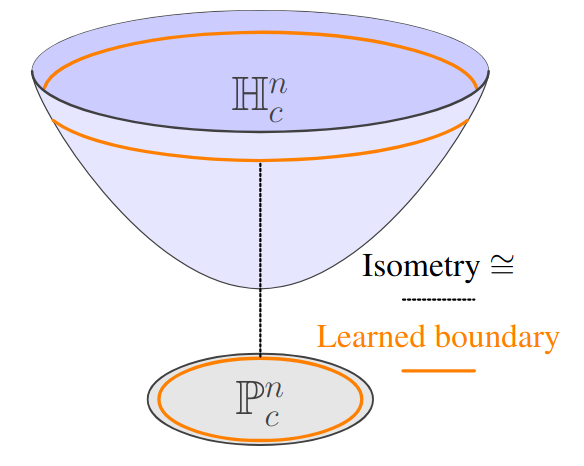
I study how different architectural and geometric priors influence the training dynamics, sample efficiency, and generalization of learning algorithms. My current research focuses on non-Euclidean (hyperbolic) representations for deep reinforcement learning. I am convinced that hyperbolic geometry provides a useful inductive bias for deep RL agents, particularly in hierarchical and compositional tasks. I do hypothesis-driven empirical research in deep RL. Traditional theoretical analysis — using tabular settings or linear function approximation — cannot explain the behaviors that emerge when deep networks are combined with RL algorithms. Therefore, I develop understanding through precisely designed experiments and rigorous empirical evaluation that maintain direct connection to algorithms used in practice. |
|
Timo Klein*, Thomas Lang*, Andrii Shkabrii, Alexander Sturm, Kevin Sidak, Lukas Miklautz, Claudia Plant, Sebastian Tschiatschek International Conference on Learning Representations (ICLR), 2026
paper
/
code
/
bibtex@article{klein2025hyperbolic,
title={Understanding and Improving Hyperbolic Deep Reinforcement Learning},
author={Klein, Timo and Lang, Thomas and Shkabrii, Andrii and Sturm, Alexander and Sidak, Kevin and Miklautz, Lukas and Plant, Claudia and Tschiatschek, Sebastian},
year={2025},
note={Under submission}
}
We identify optimization instabilities in hyperbolic deep RL caused by large-norm embeddings. Our HYPER++ agent outperforms existing works through principled regularization, improved hyperbolic layers, and a geometrically-aligned value loss. |
|
Andrii Shkabrii, Timo Klein, Lukas Miklautz, Sebastian Tschiatschek, Claudia Plant ICLR Workshop on Scaling Self-Improving Foundation Models without Human Supervision, 2025
paper
/
bibtex@inproceedings{shkabrii2025resl,
title={ReSL: Enhancing Deep Clustering Through Reset-based Self-Labeling},
author={Shkabrii, Andrii and Klein, Timo and Miklautz, Lukas and Tschiatschek, Sebastian and Plant, Claudia},
booktitle={SSI-FM@ICLR},
year={2025}
}
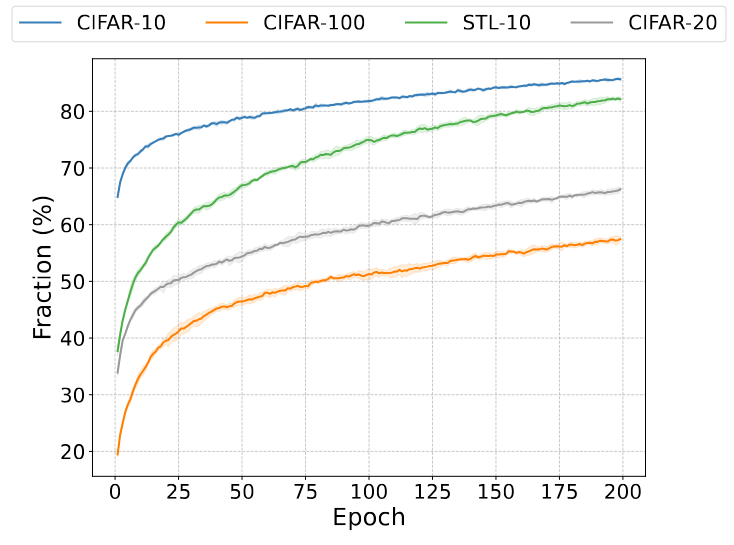
ReSL improves deep clustering by applying weight resets during self-labeling to prevent overconfidence and bias amplification on pseudo-labels. |
|
Lukas Miklautz*, Timo Klein*, Kevin Sidak*, Collin Leiber, Thomas Lang, Andrii Shkabrii, Sebastian Tschiatschek, Claudia Plant International Conference on Learning Representations (ICLR), 2025
paper
/
code
/
bibtex@inproceedings{miklautz2025breaking,
title={Breaking the Reclustering Barrier in Centroid-based Deep Clustering},
author={Miklautz, Lukas and Klein, Timo and Sidak, Kevin and Leiber, Collin and Lang, Thomas and Shkabrii, Andrii and Tschiatschek, Sebastian and Plant, Claudia},
booktitle={ICLR},
year={2025}
}
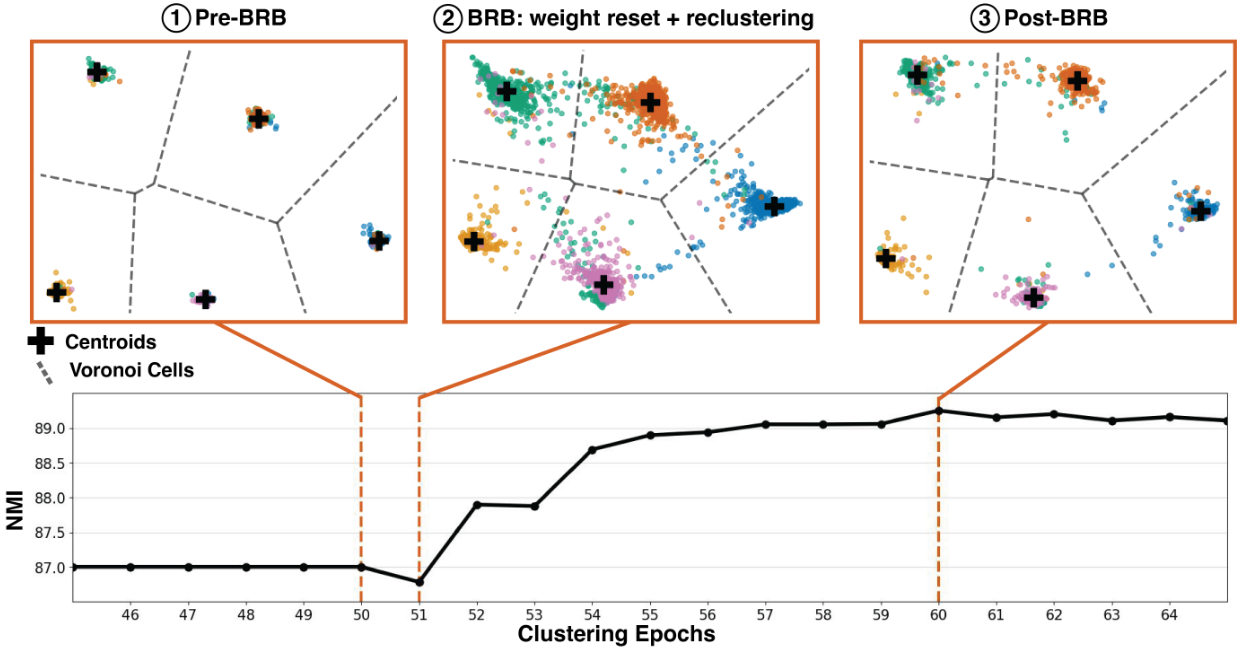
This paper identifies the "reclustering barrier" phenomenon where centroid-based deep clustering algorithms plateau after early gains. We then propose BRB, an algorithm which avoids early over-commitment through careful re-initialization, breaking the reclustering barrier. |
|
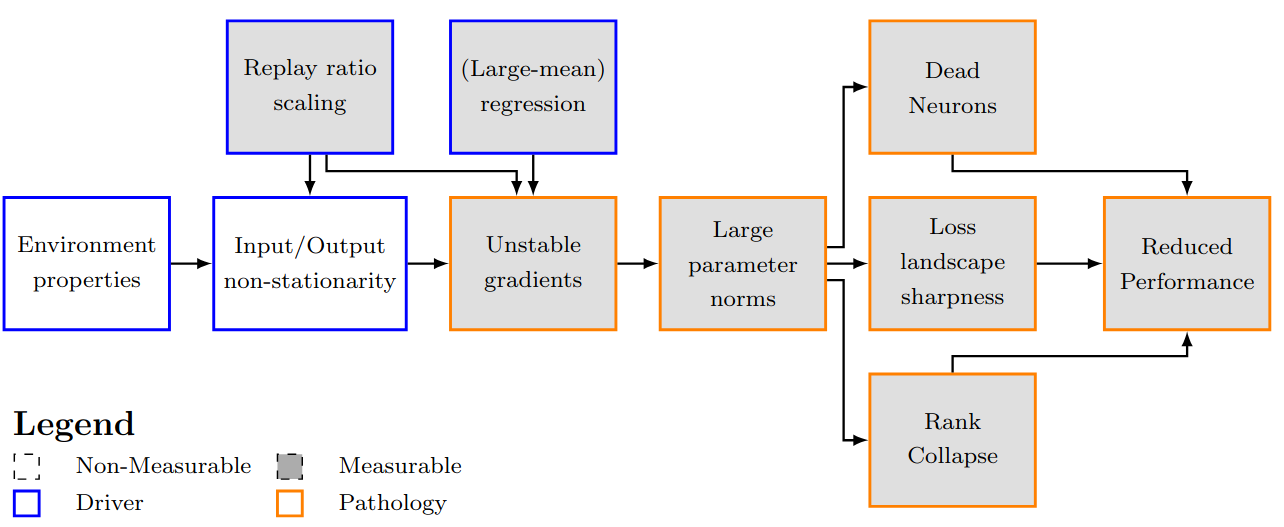
Timo Klein, Christoph Luther, Manus McAuliffe, Lukas Miklautz, Claudia Plant, Sebastian Tschiatschek Under submission, 2024
paper
/
bibtex@article{klein2024plasticity,
title={Plasticity Loss in Deep Reinforcement Learning: A Survey},
author={Klein, Timo and Luther, Christoph and McAuliffe, Manus and Miklautz, Lukas and Plant, Claudia and Tschiatschek, Sebastian},
journal={arXiv preprint arXiv:2411.04832},
year={2024}
}
This survey provides the first systematic taxonomy of plasticity loss in deep RL by categorizing drivers, pathologies, and mitigation strategies. |
|
Shengyi Huang*, Quentin Gallouédec*, Timo Klein, and others arXiv preprint, 2024
paper
/
bibtex@article{huang2024openrl,
title={Open RL Benchmark: Comprehensive Tracked Experiments for RL},
author={Huang, Shengyi and Gallouédec, Quentin and Felten, Florian and Raffin, Antonin and Dossa, Rousslan Fernand Julien and Zhao, Yanxiao and Sullivan, Ryan and Makoviychuk, Viktor and Makoviichuk, Denys and Danesh, Mohamad H. and Roumégous, Cyril and Weng, Jiayi and Chen, Chufan and Rahman, Md Masudur and Araújo, João G. M. and Quan, Guorui and Tan, Daniel and Klein, Timo and Charakorn, Rujikorn and Towers, Mark and Berthelot, Yann and Mehta, Kinal and Chakraborty, Dipam and KG, Arjun and Charraut, Valentin and Ye, Chang and Liu, Zichen and Alegre, Lucas N. and Nikulin, Alexander and Hu, Xiao and Liu, Tianlin and Choi, Jongwook and Yi, Brent},
journal={arXiv preprint arXiv:2402.03046},
year={2024}
}
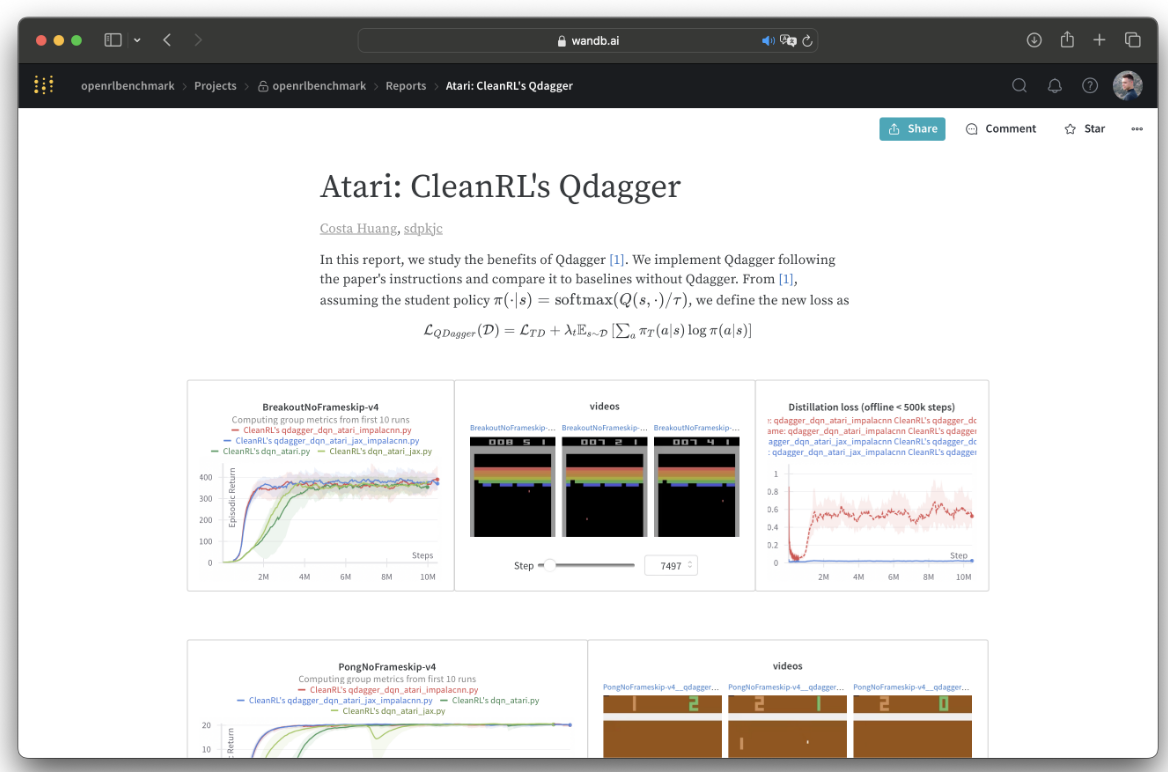
Open RL Benchmark is a community-driven repository of over 25,000 fully tracked and reproducible RL experiments with complete raw data, enabling researchers to analyze learning curves and metrics without reproducing experiments from scratch. |
|
Timo Klein*, Susanna Weinberger*, Adish Singla, Sebastian Tschiatschek arXiv preprint, 2023
paper
/
bibtex@article{klein2023active,
title={Active Third-Person Imitation Learning},
author={Klein, Timo and Weinberger, Susanna and Singla, Adish and Tschiatschek, Sebastian},
journal={arXiv preprint arXiv:2312.16365},
year={2023}
}
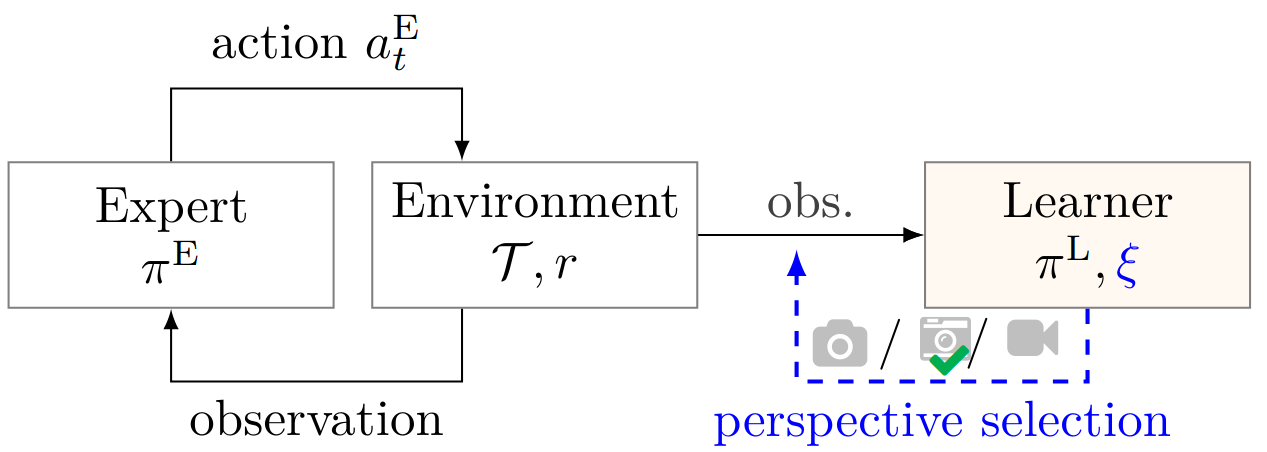
We formalize active third-person imitation learning where an agent must select and combine limited-information perspectives to effectively learn from expert demonstrations. |
|
Timo Klein*, Tanja Fenn*, Anett Katzenbach*, Heiner Teigeler, Sebastian Lins, Ali Sunyaev IEEE Access, 2022
paper
/
bibtex@article{klein2022threat,
title={A Threat Model for Vehicular Fog Computing},
author={Klein, Timo and Fenn, Tanja and Katzenbach, Anett and Teigeler, Heiner and Lins, Sebastian and Sunyaev, Ali},
journal={IEEE Access},
year={2022}
}
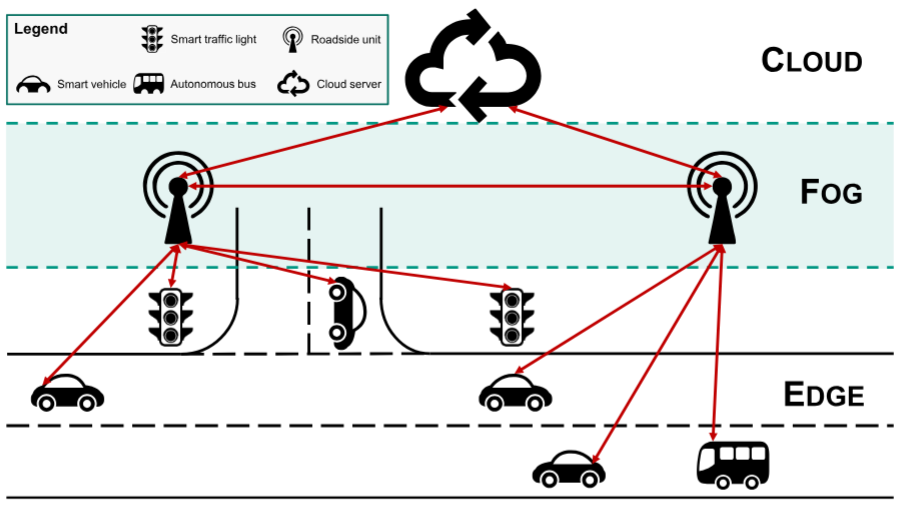
This work presents a comprehensive threat model for Vehicular Fog Computing with 33 attacks and mitigation strategies, synthesized from literature review and expert interviews, emphasizing the importance of physical attacks in cyber-physical VFC systems. |
|
Michael Färber, Timo Klein, Joan Sigloch Bir@ECIR, 2020
paper
/
code
/
bibtex@inproceedings{farber2020neural,
title={Neural Citation Recommendation: A Reproducibility Study},
author={Färber, Michael and Klein, Timo and Sigloch, Joan},
booktitle={Bir@ECIR},
year={2020}
}
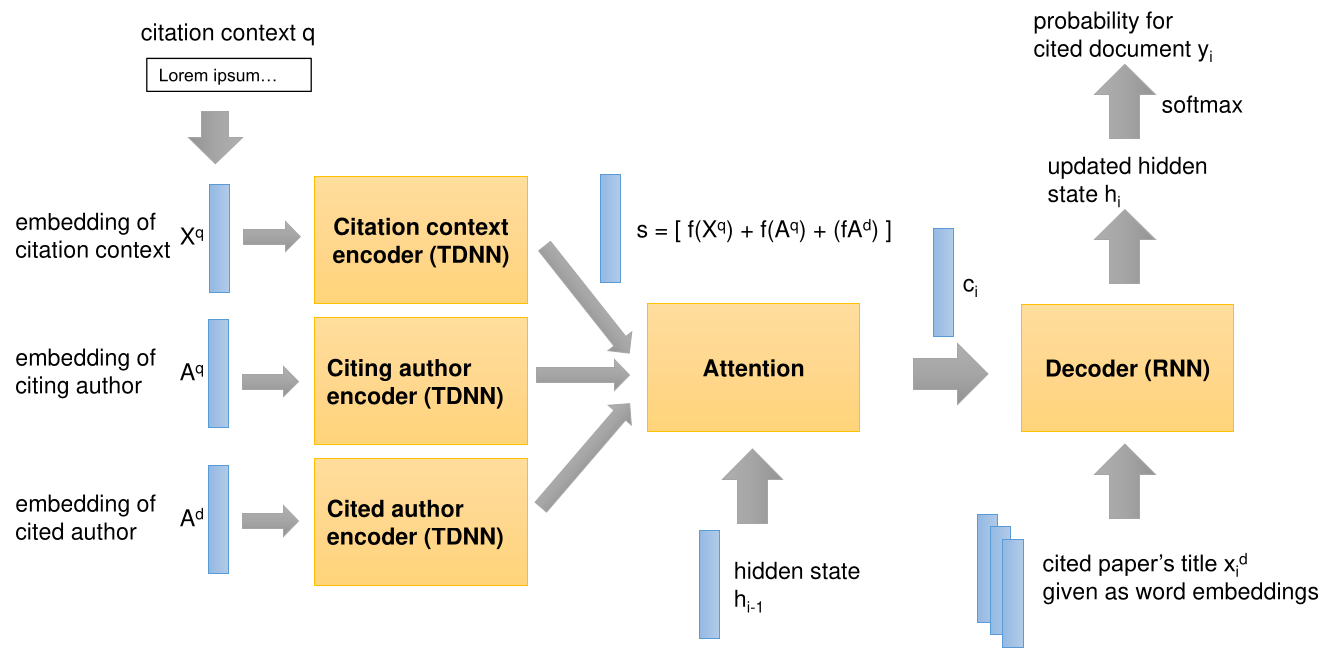
This work re-implements and evaluates Neural Citation Network for context-aware citation recommendation, analyzing hyperparameter sensitivity and model performance. |
|
At the University of Vienna:
|
|
|
|
My website is based on Jon Barron's website. The icon is from Delwar018 on Flaticon. |